Islamic Wall Art for Your Home: Kaaba, Ayatul Kursi & Calligraphy Frames Explained
27 Nov 2026 · Artwani
Walk into most homes and the Islamic frame on the wall is one of two things — a Kaaba photo or Ayatul Kursi calligraphy. We have 196 of them. That's not a random number; it's what happens when one category keeps selling and keeps growing. This guide is for the people choosing between them, and for the people buying one as a gift who don't want to get it wrong.
Three designs do most of the work. Everything else in the category is a variation on them. If you understand these three, you can pick in two minutes.
The three designs everyone actually buys
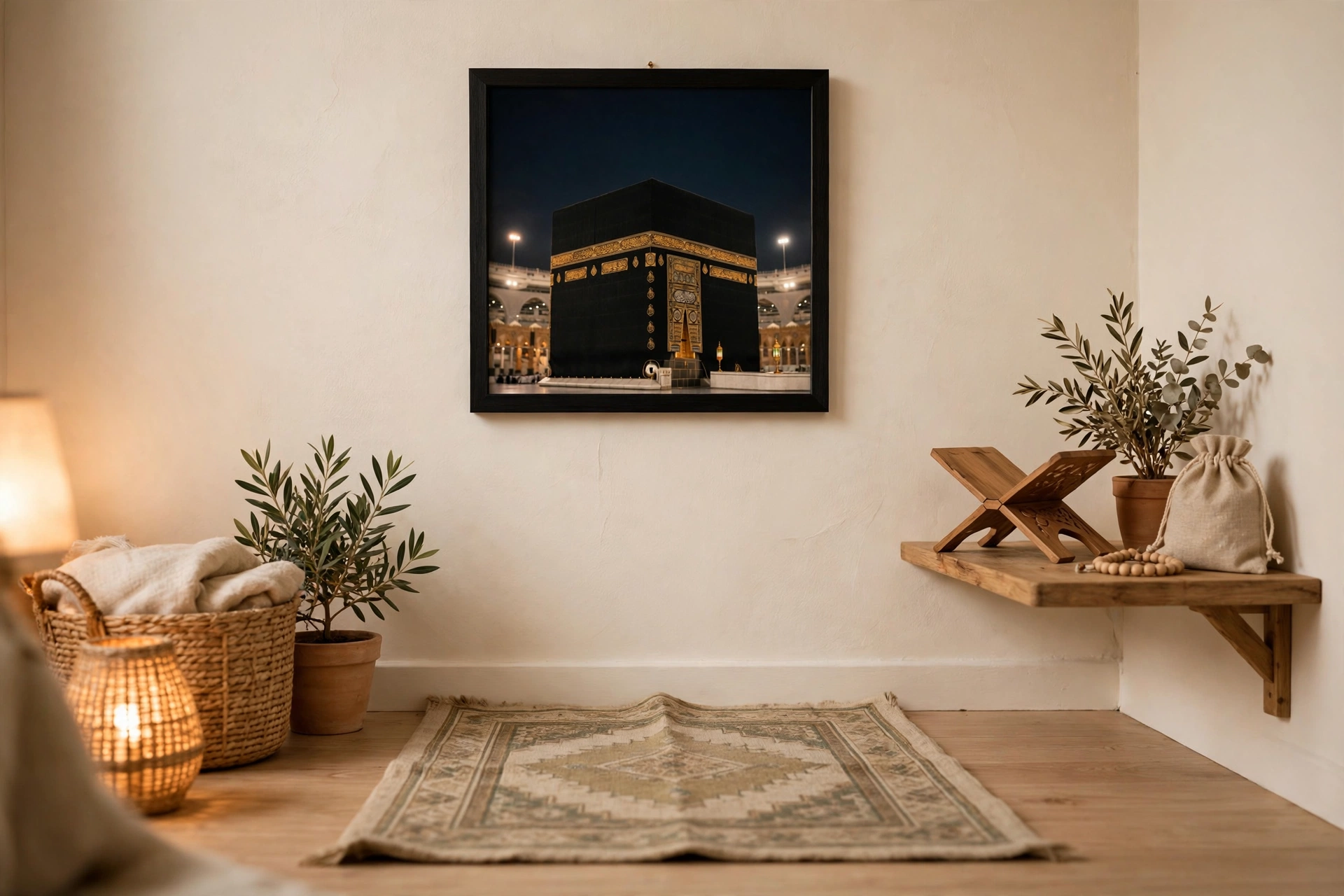
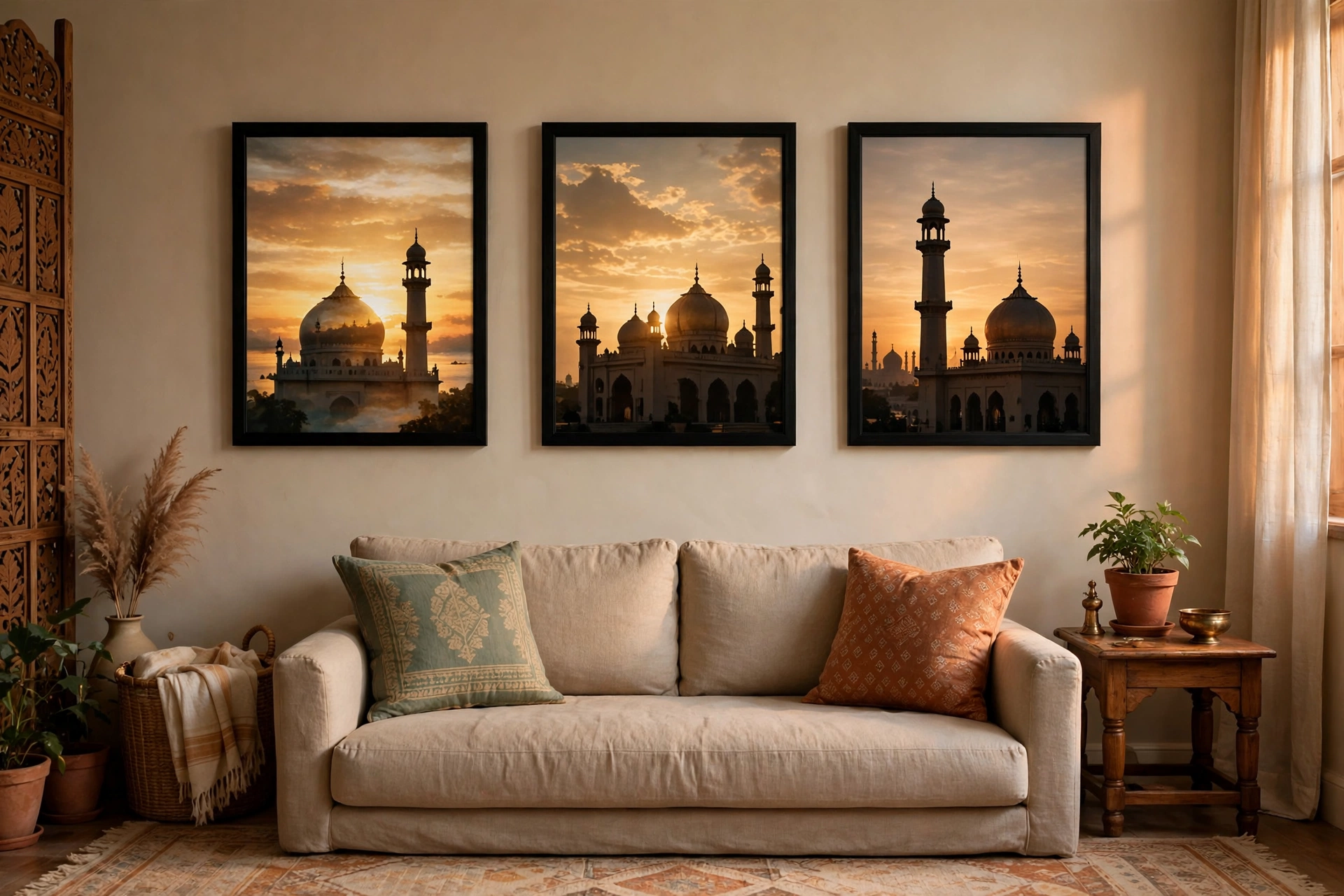
The Kaaba. A photo of the Kaaba at Makkah, usually at night or at sunset, when the lights are on and the marble glows. Makkah Kaaba Night is the one people buy for a prayer room; Golden Mosque Sunset — a set of three A4 frames at ₹499 — is the one people buy for the living room, because the warm gold tones sit well above a sofa. The Kaaba photo is the safest gift in this whole category. You don't need to know the person's taste. If they pray, it works.
Ayatul Kursi calligraphy. The verse, written out in Arabic calligraphy, usually in gold or black on a dark or cream background. This is the frame people buy for protection and blessing — for the entrance, above the main door, or in the living room where the family gathers. It's also the one people ask the most questions about, which is why there's a whole FAQ section on it below.
Bismillah calligraphy. "Bismillah ir-Rahman ir-Rahim" — in the name of Allah, the Most Gracious, the Most Merciful. Shorter than Ayatul Kursi, which makes it easier to read at a glance, and it fits smaller walls and narrower spaces. It's the one people pick for an entrance hallway or a study desk wall, where a big Kaaba photo would feel like too much.
One honest note: if you're buying for someone else and you can't decide, take the Kaaba photo. Calligraphy is beautiful, but it asks the buyer to choose a style — gold or black, modern or traditional, big or small. A Kaaba photo at sunset asks nothing of you. It just works.
Where each one goes
The design matters less than the spot. A good frame in the wrong room looks like an afterthought; an ordinary frame in the right room looks like it was always there.
Living room. This is where the set of three belongs — Golden Mosque Sunset above the sofa, or three mosque photographs in a row. One big Kaaba frame also works here, if it's the only strong image on that wall. Ayatul Kursi goes well on the wall the family faces most often, not tucked into a corner nobody looks at. Eye level is 145–150 cm from the floor to the centre of the frame; most people hang everything 15 cm too high, so check twice.
Prayer room. Keep it simple. One frame, hung where you can see it while sitting, not behind you. A single Makkah Kaaba Night or an Ayatul Kursi frame is enough — a prayer room doesn't need a gallery wall. If the room is small, an A4 is plenty. A big frame in a tiny room crowds the space and distracts from what the room is for.
Entrance. Bismillah, or a small Ayatul Kursi. The entrance frame is the first thing people see when they walk in and the last thing they see when they leave, so it should be readable at a glance — short text, clear calligraphy, nothing fussy. One frame, not three. A set of three in an entrance hallway looks like you ran out of wall everywhere else.
Kids' room. This is where people overthink it. A simple Bismillah frame, or a gentle mosque illustration, works fine. Keep it at the child's eye level, not adult eye level — a frame hung for a six-year-old should be where a six-year-old can actually see it. And keep the colours calm. Bright gold on black looks striking in a living room and loud in a bedroom.
Calligraphy vs mosque photography: which suits a modern home
This is a taste question, not a right-or-wrong one, but there is a pattern worth knowing.
Mosque photography — the Kaaba at night, a mosque at sunset, minarets against a gold sky — reads as a photograph. It fits a modern home the way any good photograph does: warm colours, real light, no explaining needed. If your home is mostly neutral walls and clean furniture, photography is the easier choice. It doesn't clash with anything.
Calligraphy reads as art. It needs a wall that gives it room — plain background, nothing competing with it. Gold calligraphy on a dark wall is striking. The same calligraphy on a busy patterned wall disappears. If your living room already has a lot going on — patterned cushions, a busy rug, shelves full of things — calligraphy will fight for attention and lose. Photography won't.
My opinion: if you're unsure, buy the photograph first. You can always add a calligraphy frame later, on a different wall, once you see how the first one sits. Two frames bought a month apart look more considered than two bought in a panic on the same day.
Set of three vs one big frame
The same rule as every other category on this site: a set of three fills a wide wall; one big frame makes a single statement.
Three A4 frames with 5–7 cm between them read as one piece from across the room, and they cover about the right width above a sofa. That's why Golden Mosque Sunset sells as a set of three — it's built for a sofa wall. One big frame is better when the image itself is the point: one Kaaba at sunset, one frame, nothing competing with it.
There's a practical difference too. Three frames are easier to hang straight than one big one. A small tilt on a big frame is obvious. A small tilt on one of three is barely noticeable, and you can adjust one without touching the others. And if you're renting, three smaller frames are easier to hang without drilling — adhesive strips hold a light A4 frame well; one heavy frame is a different job.
For a prayer corner specifically: three frames work if the wall is wide and the corner is a real corner — a mat, a small shelf, a bit of space set aside. If it's just a spot on a bedroom wall, one frame is more honest. A prayer corner made of three frames on a wall that also holds the TV looks like decoration, not a corner.
Gifting: Eid, Ramadan, housewarming, Umrah return
Islamic frames are the gift people buy when they want to say something real without spending a lot. Four occasions cover almost all of it.
Eid. Order early — a week before, at least. Delivery takes 3–7 working days, and the days before Eid are the worst time to discover your gift is still in transit. A set of three is the generous pick; a single Kaaba frame is the safe one. If you're not sure about their taste, take the Kaaba photo. It's the one nobody has ever been unhappy with.
Ramadan. This is when people buy for their own homes, not just as gifts. A new frame for the prayer room at the start of Ramadan is a small thing that changes the room for a month. Ayatul Kursi or Bismillah are the usual picks here — something you see every day and read every day.
Housewarming. A new house has big empty walls and no idea what to put on them. A set of three above the sofa solves the living room in one gift. Golden Mosque Sunset is the obvious choice; if the house leans modern, a single large mosque photograph works too. Either way, you're giving them something for the wall, not something for a drawer.
Umrah return. Someone comes back from Umrah, and you want to mark it. A Makkah Kaaba Night frame is the direct, honest choice — it's the place they just visited, on their wall. Don't overthink the size: a single A4, framed well, beats a big frame bought in a hurry. And order it after they're back, not before they leave — a gift for a return should arrive after the return.
One thing about all four occasions: these frames start at ₹499, and Partial COD is available — pay part now, the rest on delivery. For a gift, that's useful; you don't have to pay the whole thing upfront while you're still deciding.
FAQ
Is it okay to hang Ayatul Kursi in the bedroom?
Opinions differ on this, and it's worth saying that plainly. Many families do hang Ayatul Kursi in the bedroom; many others prefer to keep Quranic verses in the living room or prayer room instead, out of respect for the text. There isn't one answer everyone agrees on. The common, comfortable choice is the living room or the prayer room — that's where most of the frames in this category end up. If you're buying for someone else's home and you're unsure, a Kaaba photo avoids the question entirely.
Which design is best for a gift?
A Kaaba photo, especially Golden Mosque Sunset or Makkah Kaaba Night. It's the least likely to miss. Calligraphy is personal — it depends on their taste in style and colour. A mosque photograph doesn't ask those questions.
How long will delivery take before Eid?
Delivery takes 3–7 working days across India, and ready-made frames dispatch in 24–48 hours. Order at least a week before Eid to be safe, and earlier if you can — the last few days before Eid are busy for every courier.
Can I pay Cash on Delivery?
Partial COD is available — pay part now and the rest on delivery. UPI, cards, netbanking and wallets are also accepted.
What if the frame arrives damaged?
There's a 7-day replacement for damaged or wrong items. Check the frame when it arrives and keep the packaging until you've looked it over.