
How to Hang Photo Frames Without Nails (Renter-Friendly, No Damage)
27 Nov 2026 · Artwani
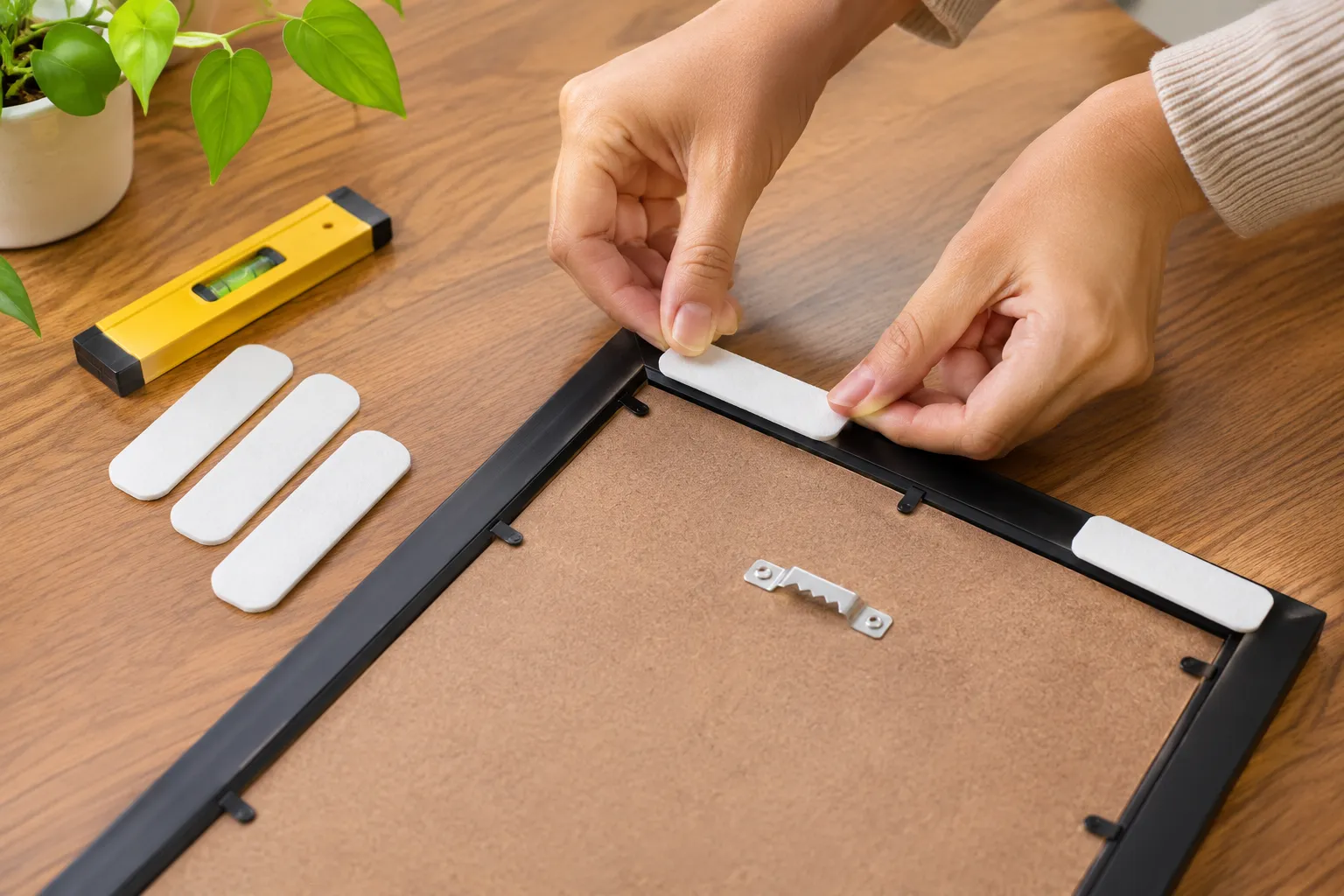
Ask any landlord in India and they'll tell you the same thing: no drilling. Ask any tenant and they'll tell you the same thing back: the walls look empty without frames. Both are right, which is why most rented flats end up with bare walls and a stack of frames leaning against the cupboard.
It doesn't have to be that way. A normal A4 frame — the size most people actually buy — hangs fine without a single nail. The trick isn't a magic product. It's matching the method to the weight, and the weight to the wall. Get those two right and nothing falls at 2 in the morning.
Weigh the frame first (before buying anything)
This is the step everyone skips, and it's the reason frames fall.
Pick up the assembled frame — photo, glass, backing, everything in it — and weigh it on a kitchen scale. That's the number that decides everything else. Not the size, not what the packet says, not what worked for your friend's frame. Your frame, on your scale.
Why it matters: adhesive strips and hooks are sold by rated weight, and the rating is per pair, not per strip. If your frame weighs 1.5 kg and the packet says "holds up to 2 kg per pair", you're fine. If it weighs 2.5 kg and you used one pair rated for 2 kg, you've built a slow-motion accident. It won't fall today. It'll fall on a humid day in July, probably at night, probably onto something you like.
One more thing while you're weighing: a set of three A4 frames is three separate weights, not one. Each frame gets its own strips. Don't try to hang all three off one clever arrangement — that's how the middle one ends up on the floor.
Strips vs hooks vs ledges — pick by weight
There are really only three ways to do this, and each one has a weight range where it works and a range where it doesn't.
| Method | Best for | Watch out for |
|---|---|---|
| Adhesive strips (picture-hanging type) | Frames up to the rating on the packet — check it before you buy, and use the number of strips the packet says for that weight | Weak on textured or dusty walls; don't use in bathrooms or right above a stove |
| Adhesive hooks | One frame hung from a single point, or a frame with a hanging wire | The hook is only as strong as its stickiest point — heavy frames pull at one spot |
| Picture ledge (a narrow shelf) | Several frames leaned against the wall, or frames you keep swapping | The ledge itself still needs fixing to the wall — some ledges use screws, so check before buying |
My honest pick for most people: strips. They're the cheapest, they leave the least mess, and a set of three A4 frames on strips is a ten-minute job. Hooks are the backup for frames that don't sit flat against the wall. Ledges are lovely if you change your frames every few months, but they're a bigger commitment — and if the ledge needs screws, you've defeated the whole point.
A note on what to buy: get strips made for picture hanging, not the general-purpose ones. The picture ones are foam-backed, they spread the weight, and they come off cleanly. The cheap clear ones from the stationery shop are for paper, not frames. They'll hold for a week and then give up.
Indian walls: what holds, what fails
Not all walls are the same, and this is where the generic advice from American websites falls apart. Most Indian flats have one of three wall surfaces, and they behave very differently.
Smooth painted plaster (Asian Paints / distemper on putty). This is the best case. Strips hold well here — it's what they're designed for. Wipe the spot with a dry cloth first. Dust is the enemy: a wall that looks clean still has a thin layer of it, and the strip sticks to the dust, not the wall.
Textured walls (popcorn finish, rough plaster, stone cladding). Strips struggle here because only the high points touch the strip. If your wall has a visible texture, press a strip against it and look — if you can see gaps, don't trust it. Hooks sometimes do better because they concentrate on a smaller area, but honestly, a textured wall is the one case where I'd say lean the frame on a shelf or a ledge instead of fighting the wall.
Tiles (kitchen, bathroom). Strips actually hold very well on smooth tile — better than on paint, in some cases. The catch is moisture and heat. Above a gas stove or inside a bathroom that steams up daily, the adhesive softens over time. If it's a kitchen wall, pick a spot away from the stove.
And one thing that applies to all three: don't hang a frame on a wall that's still damp from the monsoon, or on fresh paint that's less than a month old. Fresh paint peels with the strip. Damp walls don't hold anything. Wait, or pick another wall.
Hanging a set of 3 frames straight (the paper-template trick)
A single frame is easy. Three in a row is where people go wrong — one ends up 2 cm higher than the others and you notice it every single day. Here's the method that actually works, and it costs nothing.
Step 1 — Mark the centre. Stand where the frames will go and find the centre of the wall space — usually the centre of the sofa below it. Mark it lightly with a pencil. Everything measures out from this point.
Step 2 — Cut paper templates. Take old newspaper or brown paper and cut three rectangles the exact size of your frames. Tape them to the wall where the frames will go. This is the whole trick: paper is free to move, frames are not.

Step 3 — Set the gaps. Leave 5–7 cm between the paper rectangles. Step back, look, adjust. Too close and they read as one broken picture; too far apart and they look like strangers. Eye level is 145–150 cm from the floor to the centre of the middle frame — most people hang everything 15 cm too high, so check twice.
Step 4 — Mark the strip positions. With the paper still up, mark the top edge of each rectangle and where the strips will sit. Then take the paper down, one rectangle at a time.
Step 5 — Stick the strips. Put the strips on the back of the frame first, not the wall — press firmly for 30 seconds each. Then press the frame to the wall at your marks and hold it for another 30 seconds. Don't hang anything heavy on it for an hour; the adhesive needs that time to bond properly.
Step 6 — Check with a level. A phone with a level app works fine. Check the middle frame, then the two sides. If one is off by a hair, peel it off now — strips can be repositioned once, right after sticking, before they fully set.
The paper step feels like overkill until the first time you skip it. Then you spend twenty minutes moving frames around by millimetres while the strips lose their grip. Do the paper.
Taking them down without peeling the paint
This is the part everyone skips reading, and it's the part that decides whether you get your deposit back.
Adhesive strips are designed to come off cleanly — but only if you remove them the way the packet says. Don't just pull the frame off the wall. That rips the strip, and the strip takes paint with it.
Instead: lift the bottom of the frame gently and pull the strip tab straight down, slowly, along the wall — not outwards, not at an angle. The strip stretches, thins out, and lets go. If there's no tab visible, slide a piece of dental floss or fishing line behind the strip and saw gently downwards. Same idea: slow, along the wall, never outwards.
If the paint does peel a little — it happens, especially on old distemper — a dab of white toothpaste in the nick, smoothed with a fingertip, hides it well enough for a landlord inspection. That's not a joke; it works. For anything bigger than a coin, keep a small tin of the same wall paint. A ₹200 tin has saved more deposits than any hanging method.
And when you move out: take the strips off the wall, not just the frames off the strips. The little foam squares left behind are the thing landlords actually notice.
FAQ
Will adhesive strips hold a wooden frame? It depends on the weight, not the material. Weigh the frame — if it's within the rating on the strip packet, it holds. If the frame is heavy, use more strips (the packet tells you how many per weight) or switch to hooks. Don't guess; weigh it.
What about rented flats — is this really deposit-safe? If you use proper picture-hanging strips and remove them the right way (pull down along the wall, slowly), yes — that's exactly what they're made for. The risk is cheap strips, textured walls, and pulling them off outwards. Get those three right and the wall looks untouched.
Can I hang a set of 3 A4 frames with strips? Yes — that's the most common setup. Each frame gets its own strips, 5–7 cm gaps between them, centre at eye level. Golden Mosque Sunset, Himalayan Sunrise and Boho Rainbow Arch all come as sets of three A4 frames and hang exactly this way.
How long do the strips last? On a dry, smooth wall indoors, years. Heat and steam shorten that — keep frames away from stoves and steamy bathrooms. If a frame starts to tilt or a corner lifts, take it down and replace the strips rather than pressing it back and hoping.
What if my wall is textured and nothing sticks? Lean the frames on a shelf, a sideboard or a picture ledge instead. A set of three leaning against the wall on a console table looks intentional, not like a compromise — and it costs you nothing in damage.